Physics
Doppler Effect
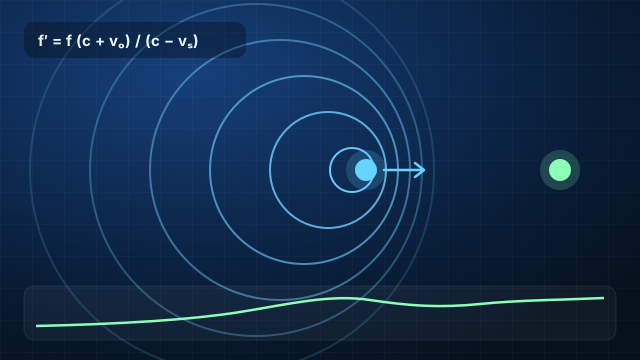
Move a sound source and an observer, change the speed of sound and the wind, and watch the observed frequency shift — all the way to a supersonic Mach cone.

Send a sound or electromagnetic wave into a slab of water, glass, concrete, metal or lead and see how much is reflected, absorbed and transmitted.
Why does Wi-Fi fade behind a concrete wall while light passes through glass? Why does a thin sheet of metal block radio but not sound? This simulator sends a wave from air into a slab of material and back out into air, and shows the three possible outcomes: part of the energy is reflected at the boundary, part is absorbed inside, and the rest is transmitted.
Acoustics uses the acoustic impedance Z = ρc with multiple reflections inside the slab. Radio to optical waves use the complex impedance of a lossy dielectric or conductor, and very high frequencies switch to exponential photon attenuation. The material values are educational approximations.
Give each group one material and ask them to find the frequency at which transmission drops below 10%. Then compare results across groups: metals behave very differently for sound and for radio waves, which makes a good discussion about conductivity and impedance.
Move a sound source and an observer, change the speed of sound and the wind, and watch the observed frequency shift — all the way to a supersonic Mach cone.

Build reciprocal lattices, explore 3D Brillouin zones and simulate X-ray diffraction with Bragg’s law, structure factors, band structures and peak fitting.