PhysicsChemistry

3D Brillouin Zone & Bragg Diffraction

Build reciprocal lattices, explore 3D Brillouin zones and simulate X-ray diffraction with Bragg’s law, structure factors, band structures and peak fitting.

Open full screen
Levels
University
Languages
English
Type
3D · Any modern browser
Price
Free
Created by
Seyed Hamzeh Hosseini

Overview

Solid-state physics lives in reciprocal space, which is hard to picture from equations alone. This simulator makes it visible. Build a lattice, see its reciprocal lattice and Brillouin zones in 3D, and connect them to the diffraction pattern you would measure in the lab.

What you can explore

  • Real and reciprocal lattices, with adjustable lattice constants and angles.
  • Brillouin zones in 2D and 3D, with high-symmetry points.
  • Bragg’s law 2d sin θ = nλ, the Laue condition and the Ewald sphere.
  • Structure factors and extinction rules for BCC, FCC, diamond and HCP structures.
  • Band models (free electron, nearly free electron, tight binding), Fermi surfaces and phonon dispersion.
  • Diffraction patterns, d-spacing tables, peak ranking, Scherrer crystallite size, Debye–Waller temperature effects and peak fitting with Lorentzian, Gaussian and pseudo-Voigt profiles.
  • Export tables as CSV and plots as PNG for reports.

Learning goals

  • Construct the reciprocal lattice of a given crystal lattice
  • Identify the first Brillouin zone and its high-symmetry points
  • Apply Bragg’s law and the Laue condition to predict diffraction peaks
  • Use structure factors to explain systematic absences in BCC, FCC and diamond crystals
  • Relate band structure and Fermi surfaces to the Brillouin zone
  • Estimate crystallite size from peak width with the Scherrer equation

Teaching tips

Pair this simulator with a real powder X-ray diffraction pattern. Ask students to index the peaks, then check which reflections disappear when switching from simple cubic to BCC and FCC. The CSV export makes it easy to build a lab report.

Physics

Doppler Effect

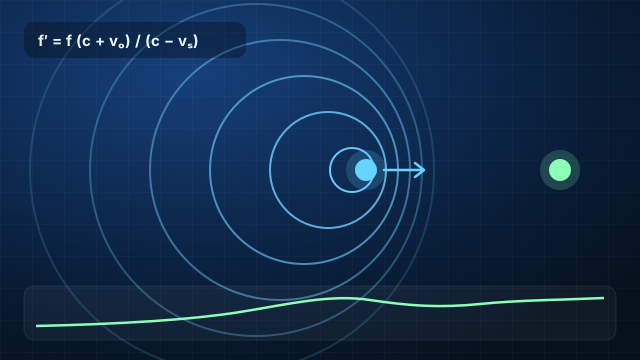
Move a sound source and an observer, change the speed of sound and the wind, and watch the observed frequency shift — all the way to a supersonic Mach cone.

Middle school+ 2D
PhysicsEngineering

Wave Propagation Through Materials

Send a sound or electromagnetic wave into a slab of water, glass, concrete, metal or lead and see how much is reflected, absorbed and transmitted.

High school+ 2D