
PhysicsEngineering
Wave Propagation Through Materials
Send a sound or electromagnetic wave into a slab of water, glass, concrete, metal or lead and see how much is reflected, absorbed and transmitted.
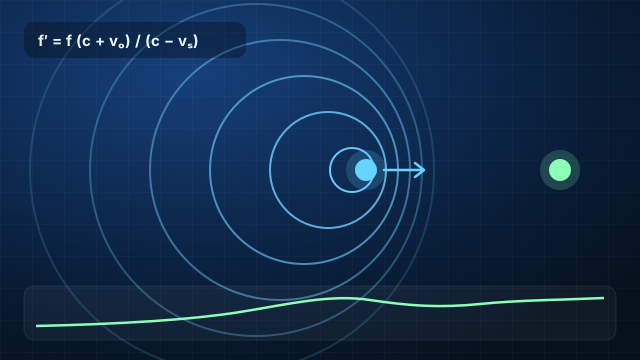
Move a sound source and an observer, change the speed of sound and the wind, and watch the observed frequency shift — all the way to a supersonic Mach cone.
Why does an ambulance siren sound higher as it comes toward you and lower after it passes? This simulation lets you see the answer. The source sends out circular wavefronts; when it moves, the fronts bunch up ahead of it and spread out behind it, so the observer meets crests more (or less) often.
A presentation mode hides the side panel so the stage fills the projector, and the whole simulation switches between English and Persian with one click.
Start with the slow motion scenario and ask students to count crests reaching the observer each second. Then switch to approach and away and have them predict the graph before you press Start. The supersonic scenario is a good bridge to sonic booms.
Send a sound or electromagnetic wave into a slab of water, glass, concrete, metal or lead and see how much is reflected, absorbed and transmitted.

Build reciprocal lattices, explore 3D Brillouin zones and simulate X-ray diffraction with Bragg’s law, structure factors, band structures and peak fitting.